
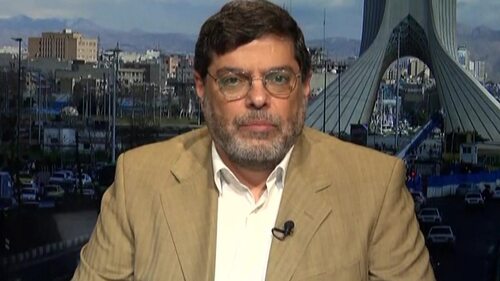
Dr. Marandi, who is an unofficial spokesman for President Mahmoud Ahmadinejad’s government, is an assistant professor of English Literature at the University of Tehran and head of Department of North American Studies. He spoke to insideIRAN.org from Tehran.
Q: It seems a bit irrelevant to think of Thursday in terms of which side lost or won. Rather, it is clear that there is a part of the population that is dissatisfied with the state. What do you see happening in the near future? Will there be a political compromise of any sort? A unity government, for example? How will the state address the grievances of part of the population?
A: On the contrary, it is very relevant if you mean the events on the anniversary of the Islamic Revolution. Thursday was a humiliating defeat for the so-called Green Movement. First and foremost, because over the past few weeks they were saying that it would be a victory for them. It was clear that this would not be the case, and many of us have been saying this all along, but the Western media and Western governments, as usual, rely on so-called Iran experts that are for the most part pretty ignorant about the reality in Iran and who often have a vested interest in keeping Iranian-American relations tense. The pro-Islamic republic rallies held simultaneously in Tehran and in all other Iranian cities were enormous and significantly larger than the previously unprecedented pro-Islamic Republic rallies that were held on December 30, 2009 three days after the Ashura riots. The people have spoken.
Of course, they made the ludicrous claim that people were bussed in or that they were given drinks and sandwiches. However, the fact is that since each city had its own rally, which was very large, this claim is absurd. The fact that many in Tehran used public services to get to the rally, does not mean that they were bussed in. That is what all major cities do to decrease traffic and to prevent air pollution. In fact, since I left the demonstration in Tehran a bit early, I saw that many people were still stuck in their cars and hadn’t reached the Tehran rally when the ceremony came to an end, because of the very heavy traffic. To claim that people would travel for hours from one side of Tehran to the other for a drink or a piece of cake is not only demeaning, but I believe at one level, it boarders racism.
The recent demonstrations were a very powerful vote of confidence for the Islamic Republic of Iran and it shows that the tens of Farsi television channels, countless websites, and political entities funded by the U.S. government, with US taxpayer money, have ultimately had no meaningful effect. In fact, one could argue that today the Islamic Republic of Iran is in many ways stronger, more popular, and more stable than ever before. This of course does not mean that everyone who attended the celebrations supports President Mahmoud Ahmadinejad. Many who attended were principlists (moderate conservatives) who are critical of the government and reformists who have nothing to do with the so-called Green Movement. However, all were supporting the Islamic Republic and were very much opposed to foreign-backed groups.
Nevertheless, there is no doubt that President Ahmadinejad enjoys the support of a strong majority of Iranians.
In politics there are always compromises, but it is highly unlikely this will happen with the leaders of the Greens. They have gone too far. Whether people in the United States accept it or not, they are very unpopular and people are very angry with the Greens and their leaders. The vast majority of Iranians support the Islamic Republic and believe that grievances should be dealt with through elections and within the framework of the law. In this election, President Ahmadinejad, who I didn’t vote for by the way, clearly won and most former Moussavi supporters accept this. None of my colleagues, who had voted for Moussavi, would vote for him again after what he did following the election. That doesn’t mean that they support President Ahmadinejad or that Moussavi has no supporters at all, but only a small minority support him now.
Q:How do you assess the opposition? It seems diverse and leaderless. Is this true?
A: It depends what one means by the word “opposition.” As I said, the President has opponents among principlists and reformists. However, if you mean the Greens, I agree, I think they have no real leader. The reason is because they are a diverse set of people who have almost nothing in common with one another. Some are Marxists, some are liberals, some are extremist nationalists, some are atheists, some are monarchists, some are religious, and so on. If these people ever came to power, in an alternative universe, they would be at each others’ throats within days. In fact, after the demonstrations celebrating the Revolution, they are already at each others throats.
Q:Would you agree that since the June election, Iran has become much more of a militarized state? If so, why is this the case? Why does the state believe it must use such force against its own citizens?
A: No, I would not. First of all, contrary to what we hear in the Western media and contrary to the absurd claims made by the Greens, the only significant unrest was in Tehran, and to be more precise, parts of Tehran.
There was never any unrest in South Tehran, which has a population roughly twice as large as North Tehran. Things are quite normal on the streets of Tehran now, and there are fewer police officers on the streets of Tehran today than in New York and, believe me, it is much safer here than in New York too.
Regarding the post-election demonstrations and riots, the fact is that the police were caught completely by surprise. Few thought that the Moussavi camp would behave in such a manner. The first few days were very chaotic in north and central Tehran, because many people, initially, believed that Moussavi had evidence for fraud, otherwise, he would not have spoken with such confidence. Of course, later when he failed to produce any significant evidence many of his levelheaded supporters became disillusioned with him and left his camp. Later when he effectively accepted the support of the western funded Farsi media and the western based opposition, through his silence, many more became disillusioned and even disgusted.
In any case, the violence had casualties. Over forty people died and 10 of them were from the disciplinary forces and the basij. That shows that some of the protestors were extremely violent. Some of them even tried to capture military bases, and in one instance, a mother and daughter from a family opposed to Moussavi died in the crossfire. Of course, many of the other protestors were the exact opposite and were completely non-violent. However, this too shows the incompetence of the movement’s leadership.
They were unable to control their own demonstrations and since the demonstrations were not legal that made things even worse, as most people blamed them for breaking the law. People were also angry that all the demonstrations and riots were in the heart of Tehran and many businesses and taxi drivers lost a lot of money. The government could have made things better by allowing Mr. Moussavi to hold rallies in a stadium or a park, but something tells me that even if they had given a permit the Moussavi team would not have ended the disturbances in the heart of the city. Who knows. In any case, these actions actually made many more people unhappy with the Moussavi camp and, after a few days when no evidence of fraud was forthcoming, more and more people in Tehran began to see the rioters as people who were trying to steal the elections through violence anyway.
Of course, the Greens say that over a hundred people were killed, but these are the same people who say that people who participated in the pro-Islamic Republic demonstrations went to get a piece of cake and a drink. They have little credibility and, in addition, it quickly emerged that some of the people who they claimed were killed did not exist and some are actually very much alive. This includes some students at my own university, the University of Tehran. Some of these students were actually Ahmadinejad supporters, such as the young girl who was accepted in the University of Tehran’s Faculty of Law.
This, of course, does not justify criminal action. Hence, in the case of the Kahreezak prison where three or maybe four people died due to police brutality, the prison was closed and twelve officers, some of them senior officers, are now in prison and on trial. I’ve spoke to my colleague Professor Rooholamini, the father of one of the victims, and he said that he and the parents of the other two victims were completely satisfied with the way the police and judiciary are handling the case. You can contact him and speak to him about this, as he is fluent in English.
One other thing that I should add is that American and European-funded television stations and websites were regularly advocating violence and encouraging mob rule. There is no doubt that they and the governments that fund them must bear responsibility and that they have blood on their hands. I’m sure that I’ll be attacked relentlessly by some of these people and I will get a new wave of death threats, but I have no option but to speak out.
Let’s also not forget that more people died in the 1992 riots in Los Angeles than in the post-election riots in Tehran and that in L.A. there were no foreign-backed television stations or websites egging people on.
Q: What lessons can be drawn from the political conflict in Iran in terms of the viability of an Islamic state?
A: There is no doubt that the Islamic Republic of Iran has strong public backing and that it is here to stay. While the police force must be better funded and trained to deal with such events more professionally and the government should be less provocative in the future, there is no doubt that today people are very angry with the foreign-backed Green movement and with the role that Western governments, through financial support and other forms of support have played in all this. Western governments and politicians should be under no illusion, the vast majority of Iranians see the Islamic Republic of Iran as a legitimate form of government and they will support it as they did a few days ago. They should realize that many of their so- called Iran experts know little about Iran, some have an agenda, some have spent very little time in Iran, some don’t even speak Farsi, but have the audacity to write articles and books about the country like the Orientalists of old. Also, their diplomats in Tehran are largely surrounded by a small group of like-minded Iranians who do not reflect or even understand the beliefs of the majority of Iranians.
Q: Why do you think part of the population is now adamantly opposed to the state? What prompted this development? The reasons are obviously deeper than the election outcome.
A: There are people in the United States that are adamantly opposed to the state, as well, and their numbers are not all that small. Does that make the U.S. government illegitimate in the eyes of the majority of Americans today? Of course not. The same is true with Iran. The state, political parties, and other civil society institutions must do their best to keep as many people on board as possible. However, while I do not want to put all the blame on foreign governments, there is no doubt that western governments have been trying desperately to destabilize Iran through soft power, psychological warfare, sanctions, and military threats and they have been encouraging people, often through the western based opposition, to pursue violence. In the short term, they has some success, but in the long run they have only further strengthened the Islamic Republic, because as time went by, more and more people began to rally around its banner with greater fervor than before. The lesson that should be learned is that Western countries are doing themselves no favors by interfering in Iran’s internal affairs, they have unified the population and they are only making rapprochement more illusive. Western countries constantly miscalculate when it comes to Iran. The danger is that if these miscalculations continue in the future and the U.S. government moves towards further confrontation, they could have severe consequences for all.